HRT Transfer of Care to a New Provider in Los Angeles: A Doctor's Guide
I'm Dr. Fernandez. I run Aurum Haven Medical (AHM), a small direct care practice in West Hollywood focused on gender-affirming hormone therapy (GAHT) with internal medicine support.
Most of what gets written about HRT is for people starting from zero. This guide is for the other group — people who are already on hormones and need to transfer their HRT care to a new provider in Los Angeles. Maybe you moved to LA. Maybe the provider you had stopped being a fit. Either way, I'll tell you from my perspective what's involved, and whether moving your care to me is worth it for your situation.
When Switching HRT Providers Isn't the Hard Part
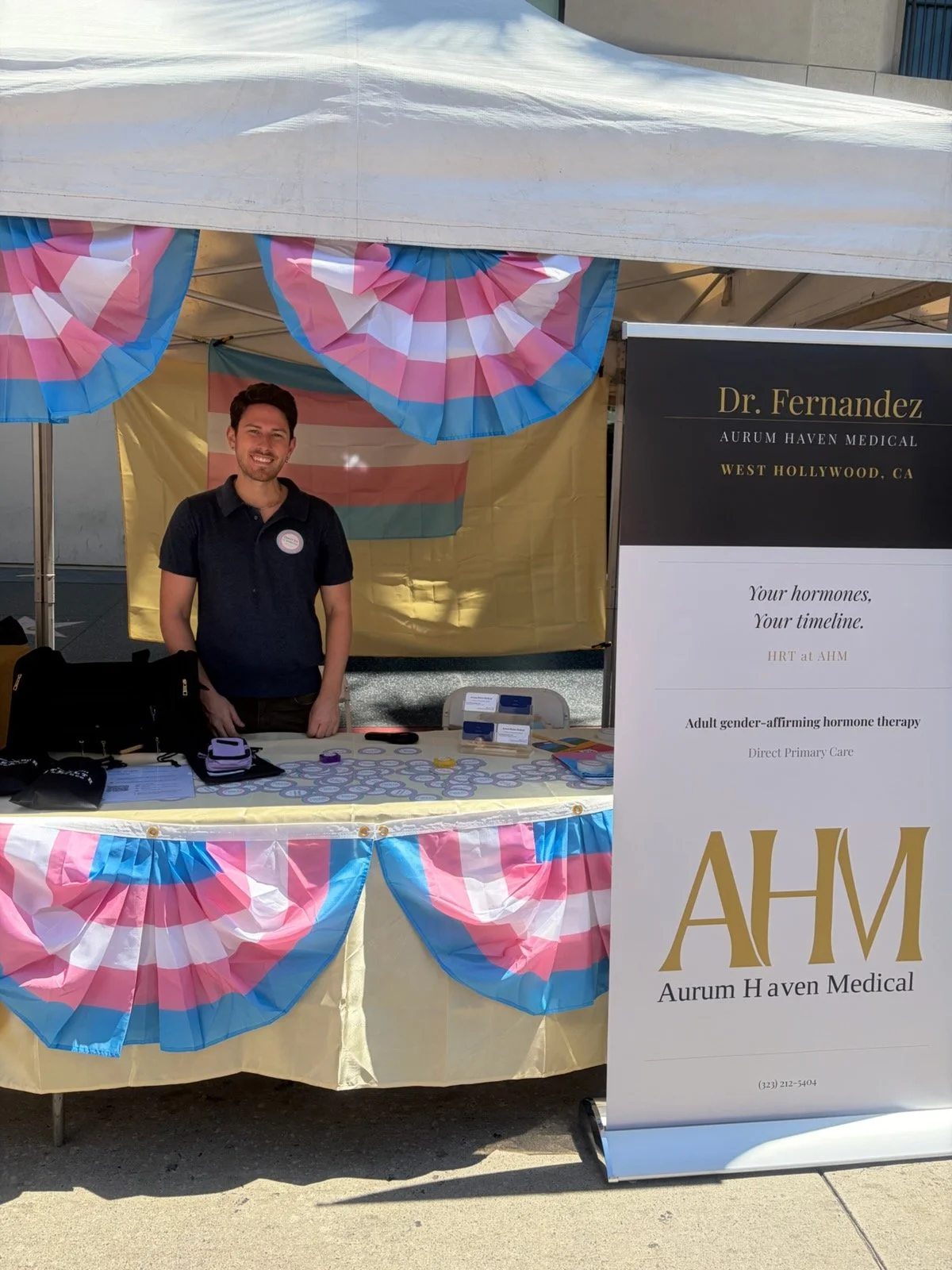
At my booth at LA Pride this year, several people came up and said a version of the same thing: I just moved here from another state, and I need an HRT doctor. That's the case I want to start with. It's common, and it's usually easier than people expect. For example, someone in that spot can get an appointment with me the same week or the next, and I’ll be a provider who can review what you're on and keep your prescriptions going safely and quickly.
In my experience the hard part isn't usually the medicine or the paperwork. It's trust — finding a provider you believe will look out for you. The World Professional Association for Transgender Health's Standards of Care support an informed consent model for adult HRT, which means you don't arrive having to re-prove that you want this care or re-justify a decision you already made. [2]
What to Bring When You Change Hormone Providers
If you can, bring your medical records — electronic or printed, whatever you have access to. The most useful thing is your recent bloodwork, ideally labs from within the last year. If you're already on HRT, any trend in your hormone levels over time helps me anticipate what's likely to happen next instead of working off a single snapshot.
It also helps to know who else you're seeing. If you have more complex needs and you're also followed by, say, a cardiologist, having the names and locations of your other providers means I can reach out to them directly.
And if you don't have your records, or you're not sure what's relevant, that's fine. We sort it out at the first visit. Sometimes that means filling out an authorization so your old clinic can fax your records over. Sometimes it means both of us reaching out to track them down. You don't have to arrive with everything in order.
Avoiding a Gap in Your HRT Medications
The fear I hear most about moving is running out of meds mid-move. Here's how I handle that.
My schedule has availability built in, so getting in quickly isn't a problem. Usually we’ll meet in person for that first visit, but we can start with a video visit if you are located anywhere in California. And if a medication isn't controlled, I can write transition-of-care prescriptions so there's no lapse while we get established. If you've moved here and you were already stable on a regimen, I'm glad to continue what's been working for you instead of reinventing your plan from the first time we meet.
One thing worth flagging: as a California provider, I can't prescribe controlled substances across state lines. For most transmasculine patients that matters, because testosterone is a controlled substance. So if you're traveling, or you haven't fully relocated yet, that's worth talking through before you run low. Estrogen and most other GAHT medications aren't controlled, so they're more flexible.
The other thing I can help with is the pharmacy mess — getting prescriptions covered, sent to the right pharmacy, and making sure your injection supplies are correct. That sounds small until it costs you three trips to the pharmacy.
If you've moved to LA or your prescription is running low, I usually have same- or next-week availability. Let's make sure you don't end up with a gap.
Why People Switch HRT Providers in Los Angeles
When I describe my model, I often compare it to Plume and FOLX, because they're recognizable and similar in some ways: a monthly membership focused on GAHT. Their platforms lean more toward integrated mental health resources. Where I differ most is being an in-person option as well as the internal medicine wraparound — examining the rest of your health in the same relationship as your hormones — and I don't think that should be understated.
I'll also be clear about what I don't do. I don't provide acute care. A flu, a bad COVID infection, that kind of acute thing — it shouldn't be triaged through me. That belongs with your primary care doctor or an urgent care. My role sits alongside that, as supplemental to your usual healthcare.
Some people who come to me were on a telehealth platform and are looking for something different now. Others moved from another state, have insurance, and just want to know their options. I like being one of those HRT options. Right now, when it can feel like access to this care is shrinking for cultural and political reasons that have nothing to do with the medicine, keeping consultation appointments available feels like its own small form of advocacy.
If you're weighing the full landscape — UCLA Health, the LA LGBT Center, Planned Parenthood, telehealth — I wrote a longer piece on how to get HRT in Los Angeles that walks through who each setting tends to work best for.
When Transferring Your HRT Care Makes Sense — and When It Doesn't
Here's my take.
If you already have a primary care doctor who manages your HRT well, and you don't have needs beyond that, you probably don't need a more intensive relationship like mine through AHM. That's a good place to be, and I'd tell you to stay in it.
The people who get the most out of working with me are usually the ones just starting hormones,the ones curious about what HRT is doing in their body, orthe analytical types who want more personal health data on how they specifically respond. If you want a provider with the time to deeply examine your regimen, transferring your care here is worth considering.
Not sure whether moving your care makes sense for your situation? That's what a short call is for.
Your First Visit When You're Already on Hormones
When someone's already established on hormones, the first visit isn't a conversation about expected effects. It's about fine-tuning what you're on and looking at the rest of your health.
Often that means seeing how your other conditions are interacting with your HRT. Sometimes it's simplifying a regimen — taking someone from a multiple-times-a-day routine to once weekly. Other times it's exploring routes of administration you haven't tried, to see whether a different dose or delivery works better for you. Regardless, together we’ll be monitoring your hormone levels after any change as part of keeping it working safely. [1]
It can also be about connecting you to resources, like surgical referrals or mental health support. If you're planning a gonadectomy, your hormonal profile may shift afterward, and having a provider with the time to send the right labs and follow the trend matters. Those labs still have to be paid for, through insurance or out of pocket, but they aren't gated behind someone’s algorithmic idea of "clinical necessity."
A Note on Privacy and Your Medical Records
Switching your care to AHM also has a privacy benefit.
AHM is located in a space that is intentionally less clinical than most doctors’ offices (and with it’s own private entrance). But also some people want to be stealth, meaning they don't want mention of being transgender sitting in their general medical record; or more commonly, most people don’t want their healthcare defined solely by their “trans-ness”. Because - NO - someone’s appendicitis does not have to do with their hormones (in the same way it may have nothing to do with someone’s asthma or high blood pressure, etc).
One benefit of a small practice like mine is that my HIPPA-protected records are separate from the large shared systems like Epic. When I was at a large academic institution, records in Epic could sometimes flow to other organizations on the same system, occasionally without the patient specifically requesting it.
An electronic record that sits outside those big networks keeps your information sequestered. You can still access it directly, but another clinic has to request it with your permission. A lot of people assume that wall is already there. Sometimes it actually isn't. [3]
Finding the Right HRT Provider in Los Angeles
If you're on the fence about transferring your care, here's how I'd frame it: it's a decision about investing in your own HRT care.
If your hormones are well managed and you don't have specific needs, the honest answer might be that you don't need to change providers.
But if you want continuity with one physician who knows your history and is mentally and emotionally present in their work, I'd be glad to talk. You can read more about what ongoing GAHT care looks like, or just reach out.
If you want one doctor who knows your history and is easy to reach, let's talk it through.
Text or call (323) 212-5404, or email info@AurumHavenMedical.com.
Sources
[1] Hembree, W.C., et al. (2017). Endocrine Treatment of Gender-Dysphoric/Gender-Incongruent Persons: An Endocrine Society Clinical Practice Guideline. Journal of Clinical Endocrinology & Metabolism, 102(11), 3869-3903.
[2] Coleman, E., et al. (2022). Standards of Care for the Health of Transgender and Gender Diverse People, Version 8. International Journal of Transgender Health, 23(S1), S1-S259.
[3] Deutsch, M.B. (Ed.). (2016). Guidelines for the Primary and Gender-Affirming Care of Transgender and Gender Nonbinary People (2nd ed.). UCSF Gender Affirming Health Program. https://transcare.ucsf.edu/guidelines
